Everything you need to write about WhenWorks — boilerplate, a founder quote, screenshots, and brand assets. We're an indie iOS app made in Sydney, and we're happy to do interviews, podcast spots, and on-the-record conversations.
Marc Ravida, founder. Replies usually within one business day (AEST).
The fast facts
Product
WhenWorks — a privacy-first iOS app for finding a time everyone's free
Founder
Marc Ravida (sole trader)
Based
Sydney, Australia
Platform
iOS (iPhone). No Android plans.
Pricing
Free at launch, with a 100-member ceiling per event. Paid tier planned for late 2027.
Tech stack
SwiftUI, CloudKit, Sign in with Apple, EventKit. No third-party servers.
Privacy posture
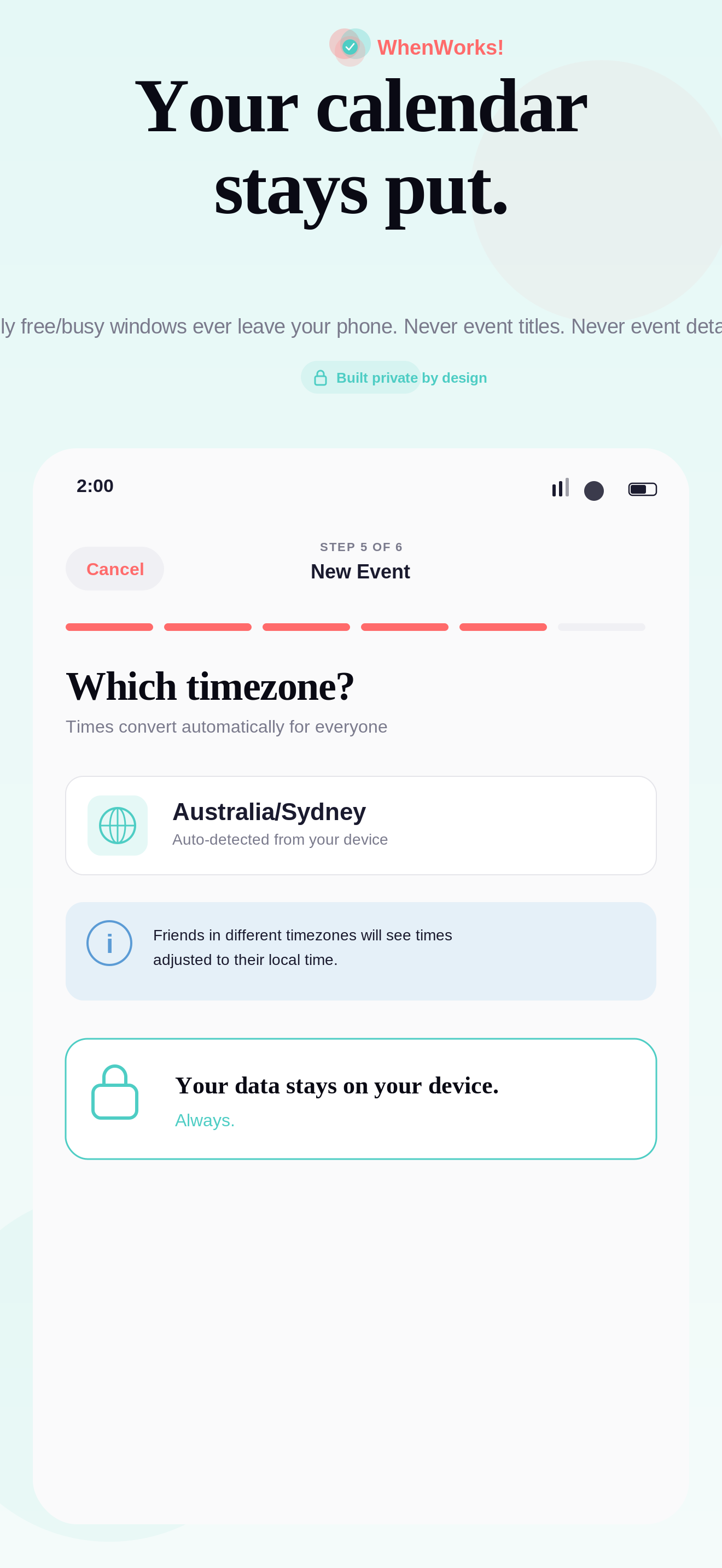
Calendars read on-device. Only free/busy windows ever leave the phone. No analytics, advertising, or tracking SDKs.
AU launch
August 2026 (Australian App Store)
Global EN launch
October–November 2026 (US, UK, CA, NZ, IE)
Boilerplate (200 words)
WhenWorks is a privacy-first iOS app for finding a time everyone is free, without the back-and-forth in group chats. Calendars are read locally on each user's device — only free/busy windows are ever shared, never event titles, descriptions, or attendees. Built on Apple's CloudKit and Sign in with Apple, WhenWorks runs without any servers of its own and uses no third-party analytics, advertising, or tracking SDKs. It supports up to 100 people per event and is free for everyone at launch. The app was created in Sydney, Australia by indie developer Marc Ravida out of frustration with Doodle-style polls and the everyday chaos of organising a family dinner. WhenWorks launches on the Australian App Store in August 2026 and on the US, UK, Canadian, New Zealand, and Irish App Stores later in the year. More at whenworksapp.xyz.
Founder quote
"Group scheduling broke a long time ago and somehow nobody fixed it. Either you send a poll link that ages badly inside an iMessage thread, or you spend a week saying 'does Thursday work?' to twelve people. WhenWorks is the simplest way I could imagine to fix that — your iPhone already knows when you're free, your friends' iPhones already know when they're free, so let's just have those phones quietly compute the overlap, and never share anything else."
— Marc Ravida, founder, WhenWorks
Why the architecture matters
WhenWorks doesn't operate any servers of its own. It uses Apple's CloudKit to sync, Sign in with Apple to authenticate, and EventKit to read calendars on-device. The implication for press purposes:
There is no WhenWorks database for an attacker to breach.
The company never sees calendar event details — it cannot, even if subpoenaed.
The free tier is structurally sustainable — there's no per-user infrastructure cost to support.
Privacy isn't a marketing layer over a normal SaaS app. It's how the system is built.
The problem. Every group chat has a coordinator. They burn five minutes a week chasing "does Thursday work?". The status quo is one of: a Doodle link nobody loves, a When2Meet that looks like 2007, or a poll inside iMessage that scrolls into oblivion.
Why it's a privacy story. Most scheduling tools either ask you to upload your whole calendar, or they ask each member to manually tick boxes. We do neither.
Why CloudKit, not a server. Building this on Apple's CloudKit means there's no WhenWorks database for an attacker to breach. It also means the free tier is structurally sustainable.
Why iOS only, why not multi-platform. Our entire architecture rides on EventKit, Sign in with Apple, and CloudKit — all Apple-only. Doing the same thing properly on Android would require asking people to upload their calendar to Google's servers, which is exactly the privacy compromise we set out to avoid.
Why now. Apple's privacy positioning has been sharpening for half a decade. Privacy-first is the default expectation for a serious indie iOS launch.
What's next. Free with a 100-member ceiling at launch. Pro tier in 2027 (free for groups of 8, paid for larger). Anything you create in v1 will keep working.